


Table of contents
During Bay Area 100, was there a moment on the trail when you felt especially connected to the land, your heritage, or something larger than yourself?
There were multiple moments where I felt deeply connected to the land, my heritage and something larger than myself. I found myself alone on the trail just before sunrise and moving through the hills in complete silence except for the sound of my footsteps and breathing. In that moment, I felt deeply connected to the land and to my Diné roots. Running long distances has always felt like more than a sport to me, it’s a way of honoring the strength, resilience, and perseverance that have been passed down through generations.
As the day unfolded and the miles became harder, I found myself thinking about my ancestors and the challenges they endured. It reminded me that discomfort is temporary, but our connection to who we are and where we come from is enduring. The Bay Area 100 was not just a test of physical endurance, it was a reminder that I carry my family, my community, and my culture with me on every step of the trail. Those moments of reflection made me feel part of something much larger than myself.
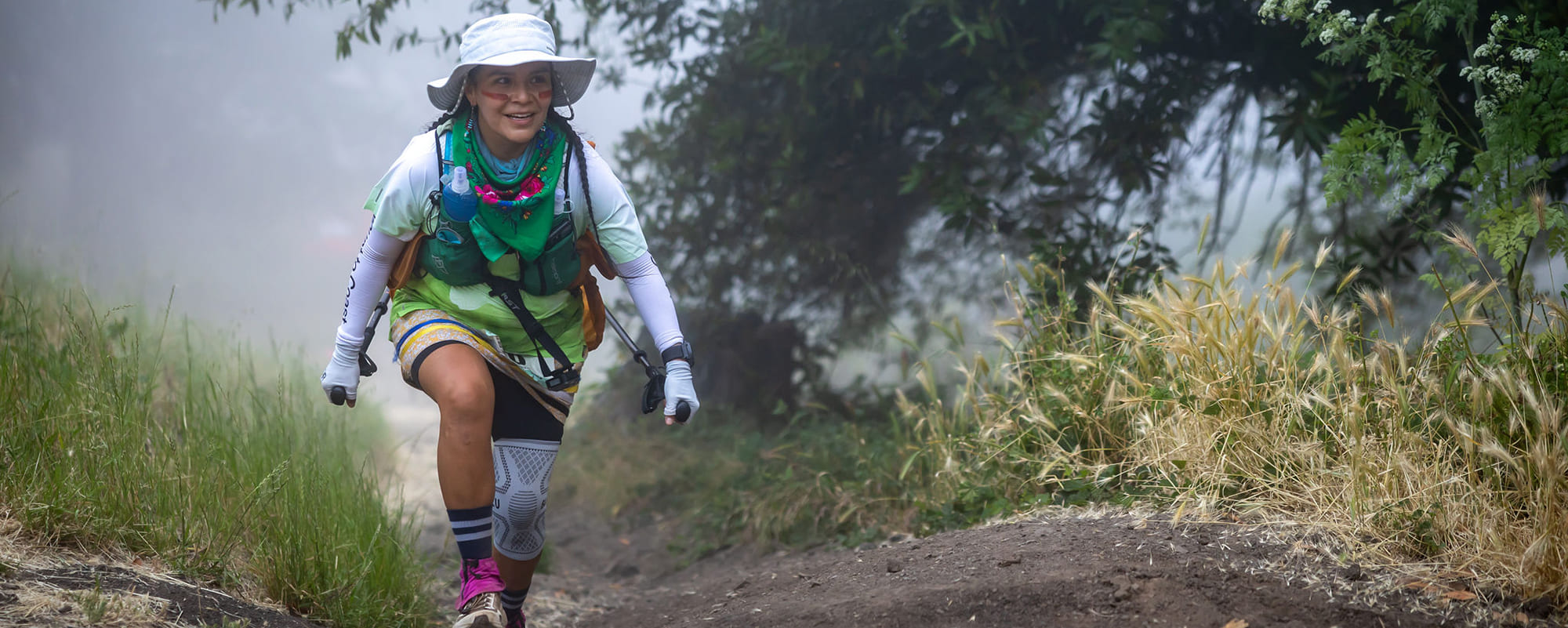
One of the most powerful moments for me came at the very beginning of the race. As we started climbing the first steep hill, the trail was completely covered in fog. In the Diné/Navajo culture, when the mist or fog is closest to the earth, it is believed that the Holy Beings are present. Standing in that fog, I felt connected to something much larger than myself.
It was a humbling and deeply spiritual experience. Although I was not on my own ancestral homeland, I could feel the medicine, strength, and presence of the people who have walked that land before. I felt the energy of their ancestors and a profound respect for the history held within those trails. In that moment, the race became about more than running, it became a reminder of our connection to the land, to our ancestors, and to the spirit that carries us forward.

At any point during the race, did you feel like giving up? How did you push yourself to keep going, especially during the night or the hardest sections?
Absolutely. There was one specific moment during the race when I thought about quitting. A few days before the race, I was dealing with stomach issues and wasn't able to eat much. Going into race weekend, I was worried about how I was going to make it through 100 miles with so few calories in my system. Fortunately, by race day my stomach was feeling much better, but I was still starting the race at a deficit and trying to play catch up with my fueling all day.
The hardest moment came around mile 47 on the climb up Mt. Trumpas. It was full sun exposure during the hottest part of the day, and I was running on very little food intake. Normally, I love climbing and feel strong on the ups, but that day was different. My body just didn't have the fuel it needed, and every step felt harder up that mountain than it should have.
When I finally reached the aid station on the other side of Mt. Trumpas, I had a moment, I sat down, cried, and allowed myself to feel everything I was experiencing, frustration, hot, sad, hungry, tired. I remember saying out loud, “I don't know how I'm going to make it back up there with so few calories in my body,” and at the same time saying, “It's taking everything in me not to quit right now.” But deep down, I knew my stubbornness wasn't going to let me stop.
I gave myself a few minutes, ate what I could, cooled down, and started moving again. It was frustrating because I knew what I was capable of on fresh legs and proper fueling, and I wasn't able to access that strength the way I normally would. It also took a long time for my body to recover from the heat. Still, I made the decision to keep going.
At that point, I knew I would be chasing cutoffs for the rest of the race. So I made a deal with myself, “keep moving until someone tells you that you can't anymore.” I stopped worrying about the finish line and focused on getting to the next aid station. Somehow, I managed to make the next three cutoff times by only a few minutes each.
What kept me going was remembering why I was out there. I wasn't just running for myself. I was carrying my family, my community, and everyone who had supported me on this journey. Even in the moments when quitting seemed like the easiest option I leaned on the teachings and resilience that have been passed down through generations. As Diné people, we come from a long line of individuals who endured hardships far greater than anything I was experiencing on the trail. Remembering that helped put my struggle into perspective and reminded me that I was capable of more than I thought. Even when my body was tired, I found strength in gratitude for the opportunity to be there, for the land beneath my feet, and for the support of my friends, other runners, crew, and community. Those reminders helped me keep moving forward when everything in me wanted to stop.
How do you turn physical exhaustion into mental strength while running such a long and challenging race?
For me, physical exhaustion and mental strength are deeply connected, especially in a race like the Bay Area 100. At some point, everyone reaches fatigue, discomfort, and doubt. What matters most is how you choose to respond when you get to those points.
When I start feeling physically exhausted, I try not to resist it, instead I acknowledge it and bring my focus back to the present, “just the next step, the next climb, the next aid station.” Breaking the race into smaller manageable pieces keeps me from becoming overwhelmed and helps me stay mentally steady when my body is struggling.
Spirituality is also a grounding force for me, as a Diné runner I carry teachings that remind me I am never alone on the land. I think about the presence of the Holy People and my ancestors and the belief that when mist and fog are close to the earth, there is a spiritual presence around us. Moments like that remind me that running is not only physical, it is also spiritual, a way of being in relationship with the land and something greater than myself. That perspective brings humility and strength when I feel empty or exhausted.
In my culture endurance and perseverance are not just individual traits, they are tied to identity, responsibility, and connection. When I am struggling on the trails, I think about my ancestors and the resilience they carried through greater hardships. That thought alone can shift my mindset from fatigue to gratitude, from doubt to determination.
The Bay Area 100 especially reinforced this. Because I started the race already behind in fueling due to stomach issues, there were moments where my body felt depleted and I questioned how far I could go. But those difficult sections also became moments of reflection. Instead of focusing on what I lacked, I focused on what I still had, the ability to move forward, to adapt, and to trust my body and spirit.
Physical exhaustion strips everything down to what is essential. For me, that is mindset, purpose, and spiritual connection. When those things align, exhaustion becomes something I move through rather than something that stops me. Each step becomes an act of resilience, gratitude, and connection to something much larger than myself.

Which part of the Bay Area 100 course challenged your body the most—the terrain, the climate, or something else? How did running at night affect your pacing, energy, or performance?
The part of the Bay Area 100 that challenged my body the most was a combination of the terrain, the heat during the day, and the accumulated fatigue, but what made it even more difficult was how all of those factors interacted with my nutrition issues early in the race.
Going in under fueled already put my body at a disadvantage, so by the time I reached the longer climbs and exposed sections, I was constantly trying to catch up. Normally I feel strong on climbs and enjoy gaining elevation, but that day my energy levels didn’t match what the course demanded. The steep terrain, full sun exposure, and rising temperatures made everything feel amplified, especially around mile 47 on the climb up Mt. Trumpas.
Night running changed the race completely. During the day, the heat and exposure were the biggest stressors, but at night it became more about pacing, focus, and managing fatigue. Without the sun and visual cues, it’s easy to either slow down too much or push in uneven bursts. I had to rely more on awareness how my body felt, how steady my breathing was, and how efficiently I was moving rather than what I could see around me.
There were also moments at night when mental fatigue started to weigh just as heavily as physical exhaustion. Your world shrinks down to the light of your headlamp and the next few steps in front of you. In those moments, pacing becomes less about speed and more about sustainability, staying steady enough to keep moving forward without burning out.
Night is usually the most difficult part of a race for me, which is why I try to cover more distance during the day and give myself a cushion before cutoff times. But in this race, I was already chasing cutoffs before sunset, so I knew I would need to put in a lot of work through the night to stay in it until morning.
As the sun went down, my pace naturally slowed. My eyelids felt heavier, and my energy dropped even more as the fatigue from the day really set in. It became harder to stay mentally sharp, and I had to stay very intentional about keeping myself moving forward.
At the same time, the cooler temperatures helped in some ways. I was able to eat a little better and tolerate fuel more consistently, which gave me just enough energy to keep climbing and stay steady on the course.
My night pace was slower than what it was doing during the day, but it was more about sustainability than speed. I focused on staying consistent, managing my effort, and reminding myself that the goal was simply to keep progressing to the next aid station and until the sun came back up.
Overall, the hardest part wasn’t just one element like terrain or climate, it was the combination of everything at once, especially while trying to manage low fuel. But running through the night also gave me space to reset mentally, simplify everything, and focus on just continuing forward one step at a time.
Do you have any nutrition tips, pacing strategies, or preparation routines that help you tackle this kind of race?
For me, success in a race like the Bay Area 100 comes down to a few simple but consistent habits, fueling early, hydrating consistently, pacing efficiently, and preparing my body and mind to adapt when things don’t go as planned.
On the nutrition side I try to fuel early and often, even when it doesn’t feel necessary yet. In long races, the goal is to stay ahead of the energy deficit. If I fall behind like I did going into this race after having stomach issues, it becomes much harder to recover later. I focus on small frequent intake rather than large amounts at once, and I adjust based on what my stomach can tolerate that day, so I train with different foods and at different parts of the day. Hydration is another piece that is important especially in a hot and humid race. I was able to hydrate well and keep up with my electrolytes which is probably helped me with some calorie intake. Hydration and nutrition go hand and hand for me on the trails.
Pacing is another key piece that I focus on, my strategy is usually to build time buffer early in the race so I’m not forced into panic mode later (at night when I move slower or may need a dirt nap). That means being disciplined during the day when I feel good, especially on runnable sections and not getting caught up in how others are moving. If I can preserve energy early but move efficiently, I have more to give when things inevitably get harder at night.
Preparation for me also includes training my mind for discomfort. I know there will be moments where I feel tired, low on fuel, or mentally drained, so I practice staying calm in those situations during training runs. That way in race conditions I can recognize those feelings without letting them take over my decisions. I cannot mimic those specific moments exactly but I can train my body to be able to tolerate uncomfortable situations and be able to problem solve.
This race reinforced all of that. Because I started the race under fueled and immediately had to play catch up, I had to shift from my usual pacing strategy into survival and management mode, especially at night when fatigue increased and energy dropped. I leaned heavily on staying steady, adjusting effort based on terrain and focusing on getting to the next aid station rather than thinking too far ahead.
At the end of the day the biggest lesson is that these races are rarely perfect and they are not all equally the same. The goal isn’t to execute everything flawlessly, it’s to problem solve, adapt, stay patient, and keep moving forward even when the plan falls apart.

Can you share a bit about your pre-race training and preparation for Bay Area 100?
My pre race training for the Bay Area 100 was a combination of consistent strength work, structured running, and an intentional recovery block leading into race day.
In general, I strength train five days a week:
I focus on lower body, legs, hips, and glutes about three times per week, and upper body and core twice per week. This helps me stay durable for long distances, repeated climbs and descents. In addition to that, I run six days a week: my running typically includes a mix of speed intervals, hill workouts, a few shorter recovery runs, and one long run each week, with one full rest day built in.
My buildup for the Bay Area 100 was unique because it came right after a heavy racing block. About five weeks before the race, I completed roughly 225 miles across two races in the Cocodona Series, the Bradshaw 100 and the Sedona Canyons 125. That quick turnaround meant my focus shifted less toward building fitness and more toward absorbing the workload and recovering well enough to toe the line again.
After the two races, I gave myself about a week of recovery before easing back into training. My intensity during this period was lighter than usual, instead of pushing hard workouts, I focused on mobility, stretching, light strength work, and prioritizing sleep to allow my body to fully recover from the intense training block for those 225 miles.
In the final week before Bay Area 100, I tapered more intentionally. I kept things light with easy jogs and minimal strength work, making sure my body felt as fresh as possible while still staying loose and ready to run.
This race wasn’t about building fitness from scratch, t was about recovery, maintenance, and trusting the foundation I had already built earlier in the season.
As a mother and as a woman, how do you find strength and balance while running a race like this?
As a mother, as a Diné (Navajo) woman, and as an Indigenous athlete, strength and balance come from understanding that I carry multiple identities with me into everything I do, including running. I don’t separate who I am on the trail from who I am in my everyday life. Instead, I try to move in a way that honors all of those parts of me together.
Being a mother has reshaped how I understand endurance. It’s taught me patience, resilience, and the ability to keep going even when I’m exhausted or stretched thin. Those same qualities show up in a 100 mile race, where there can be moments in both motherhood and ultra running where you feel depleted, but you continue forward because something deeper than motivation is guiding you.
As a Diné woman, I also carry cultural teachings and responsibilities with me. Running is not just a personal pursuit, it is connected to land, identity, and the generations that came before me. I think about the strength of my ancestors and the resilience of Indigenous people who have endured and continued to thrive despite so many challenges. That awareness gives me grounding when things get difficult on the trail.
There are also layers to being an Indigenous woman in the running space. At times, it can feel like you are navigating visibility, representation, and expectation all at once. But it also becomes a source of strength, and I am learning to trust my own voice, my own pacing, and my own experiences even when it doesn’t mirror what I see around me. That self trust is something that develops over time and deepens through races like this.
During long efforts balance comes from perspective. I remind myself that I’m not just running for a finish line I’m also running as a mother, as a Diné woman, and as someone who hopes to show what is possible. That awareness brings both responsibility and strength, especially in moments of doubt.
Ultimately, the balance comes from acceptance. I can be tired, I can be struggling, I can still be strong and I can hold motherhood, culture, identity, and be an ultra runners all at once. Instead of seeing those identities as something that pulls me in different directions, I’ve learned to see them as the source of my endurance and the reason I keep moving forward.
A huge part of how I find strength and balance in ultrarunning is my support system. I am incredibly fortunate to have a husband who is very supportive and fully steps in at home while I am out training or racing long distances. His support allows me the space to commit to these races without carrying the weight of everything alone.
My children are also a big part of that balance. They understand, at least I hope they do and if not I hope they eventually understand, what I do because I take the time to share my experiences with them and talk about why I run these long races. I want them to see that doing hard things is possible, and that pursuing something challenging can be meaningful and worthwhile. Having them understand my “why” helps me stay grounded in my own and tracing them how culturally important it is to stay connected themselves and through the land.
My mother and aunt also play an important role in my support system, especially spiritually. Their encouragement, teachings, and presence give me a sense of grounding and connection that I carry with me on the trail. As a Diné woman, that spiritual support is just as important as the physical training, it reminds me that I am never truly alone in what I’m doing.
All of this together is what makes it possible for me to step onto the start line of an ultramarathon. My support system is the foundation that allows me to push through the difficult moments, stay committed to my goals, and continue showing up for these races. Without them, I wouldn’t be able to do what I do.

What does completing Bay Area 100 mean to you personally, and what personal growth or lessons are you hoping to take from this race?
Completing, or in this case, attempting the Bay Area 100 means a great deal to me personally because I stepped onto that start line knowing I was completely out of my comfort zone. I was taking on 100 miles with over 18,000 feet of climbing and a 33 hour cutoff. The distance itself wasn’t unfamiliar, but the combination of the terrain and the strict cutoff made this one a tough and challenging race.
I ultimately missed the 2 am cutoff by six minutes, ending my morning at mile 65 with over 13,000 feet of climbing. While it wasn’t the finish I had envisioned, I still consider this race a win in many ways.
I gained experience, confidence, and lessons that I will carry into future races. This race reminded me that growth doesn’t only come from crossing finish lines. Sometimes it comes from showing up, stepping into uncertainty, and giving everything you have even when you feel like you have nothing left to give.
I found myself chasing cutoffs earlier than expected but chasing cutoffs is something I’ve experienced before in ultrarunning. But entering this race already not feeling 100% and still choosing to push forward and give it everything I had, was meaningful to me. There was a different kind of honesty in that effort, one that I can respect deeply.
Even though I didn’t finish within the time limit I learned a lot about my resilience, my decision making under pressure and my ability to keep moving forward in difficult conditions. This is a DNF I will proudly own because it reflects effort, growth, and the willingness to step into something hard without guarantees.


