

Table of contents
Most people buy a running vest, take it out for one run, and either love it or spend the whole time tugging at straps. The difference almost never comes down to the vest itself. It comes down to whether you set it up right before you left the house.

The Fit Check You Should Do Before Every Run
Fill your flasks. Put your phone, keys, and gels where they'd normally go. Put on the layer you'll actually run in. Now put the vest on.
Stand in front of a mirror and look at three things:
- The vest should sit high. The bottom edge should be around your lower ribs, not your stomach. If it's hanging low, the shoulder straps are too long or the vest is too big.
- The sternum strap should lay flat. Run a finger under it. If it's easy, it's right. If you have to push, it's too tight.
- The shoulder straps should have slack. Lift one with your finger. It should move. If it's stuck against your shoulder like a guitar strap, you've got too much tension somewhere.
Then jog in place for thirty seconds. If anything moves now, it'll move worse at mile eight.

What to Do If It Bounces
Bouncing means one of three things, in order of likelihood:
- Your load is uneven. Move heavier items closer to your back. Put equal weight in both front pockets.
- Your sternum strap is too loose. Tighten it one notch at a time. Don't go straight to maximum.
- The vest is too big. If you've tried the first two and it still swings, the torso length or chest sizing is off. No amount of strap adjustment fixes a vest that's fundamentally the wrong size.
If it rubs instead of bounces, that's usually a strap tension issue. Red marks on your collarbone mean the sternum strap is too tight. Red marks on your ribs mean the side or waist area is over-compressed. Red marks on your shoulders mean the load is sitting too high.
A Quick Look at the Lineup
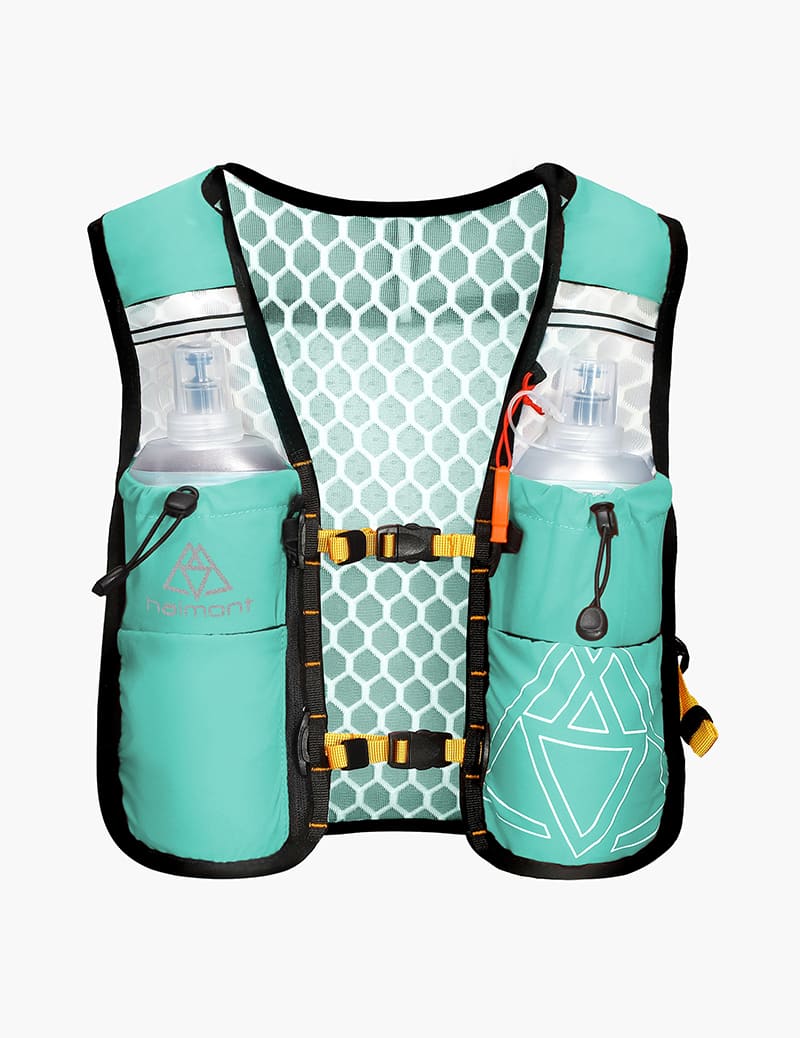
Before comparing capacities, it helps to know what you're comparing. The haimont running packs collection includes three vest sizes: 5L, 8L, and 10L. They aren't scaled-up versions of the same pack. Each one is built around a different kind of run and a different way of carrying weight.
The 5L is the minimal setup. The 8L is the long-run all-rounder. The 10L is for big trail days, races, and mountain conditions where you need more gear. The 5L features side waist adjustment straps. The 8L and 10L create stability through their cut, panel shape, and pocket layout. That matters when you start loading them up.

What Changes Between the 5L, 8L, and 10L
5L: light and adjustable
The 5L vest weighs 208g in Size M, has 10 pockets, and includes side waist adjustment. It's for 10K to half marathon runs, shorter trail sessions, or days when you only need flasks, phone, keys, and a light layer.
8L: the long-run workhorse
The 8L vest weighs 235g in Size S and has 15 pockets. It relies on a close-to-body cut to stay stable, with a pocket layout designed to spread load across your torso. The product page calls it "one vest for 80% of use cases," and that's a fair way to think about it.
For marathon training, 50K races, or long supported runs, it gives you room for nutrition, a light layer, and hydration without turning into a backpack. Because stability comes from the cut and how you pack it, load distribution matters: heavy items close to your back, flasks up front, gels where your hands naturally fall. This is the one most runners will reach for most often.
10L: for big days and mountain conditions
The 10L vest weighs 193g in Size S and has 11 larger-capacity pockets. It's designed for 50K to 100K+ efforts and mountain conditions where you may need mandatory gear, extra layers, and more water between refills.
It uses a roomier upper-body cut to accommodate broader shoulders and chests while keeping weight close to your back. If you've found smaller vests restrictive through the chest, that extra room can make a real difference. And yes, the 10L is listed lighter than the 8L and 5L in these sizes. Capacity and weight don't scale in a straight line. Larger vests can use different materials and simpler strap systems, so "bigger" doesn't automatically mean "heavier."
The Sizing Thing Nobody Tells You
Running vests are sized by chest circumference. That's the starting point, not the whole picture.
Torso length matters just as much. Two people with the same chest measurement can need different vest sizes if one has a longer torso than the other. If a vest fits your chest but hangs down to your waist, it's going to shift around your lower back no matter how tight you make the straps.
Measure over the shirt you'll actually run in. A vest that fits over a tank top might feel completely different over a long-sleeve base layer. If you're between sizes, don't assume you should size down. A slightly roomier vest that you can adjust is usually more comfortable than a snug vest that restricts your breathing.

In a Nutshell
Set up your vest before you run. Fill it with what you'll actually carry. Check the sternum strap (should be loose enough for a finger), the shoulder straps (should have slack), and the overall position (high on the ribs, not hanging low). Jog in place. If nothing moves, you're good.
If something bounces or rubs, fix the load distribution first. Then adjust straps. If it still doesn't work, the vest is probably the wrong size or cut for your body.
The full running packs collection has sizing charts for every model, so you can compare chest measurements and capacity before you commit. But the fit check is always the same, no matter which vest you end up with.