

Table of contents
Trail running vests are more than just tools for carrying supplies; they're your "second skin" during trail. They carry water and nutrition, stabilize load, assist in temperature regulation, and even directly influence your running posture and rhythm. How they perform largely depends on the fabrics used. Understanding material properties helps you make smarter buying decisions and boosts your trail performance.
We will breaks down running vest pack fabrics, key performance metrics, combination logic, and buying strategies, providing actionable insights for both novice and seasoned trail runners

Running Vest Fabric Types: What’s Under the Hood
Trail running vests are made from multiple fabric zones, each engineered for a specific purpose: durability, breathability, or stretch. Knowing what each material brings to the table is key to understanding how the vest performs in the field.
Nylon
Nylon is a synthetic polymer fiber known for its strength, abrasion resistance, and lightweight nature, widely used in outdoor gear, particularly for vest pack bodies and high-friction areas (Textiles and Fashion, 2015).
- High Strength & Abrasion Resistance: With excellent tear and wear resistance, nylon handles rocks, shrubs, and other rough terrain.
- Elasticity & Shape Retention: Nylon’s bounce helps maintain pack shape under dynamic loads.
- Lightweight: Low density reduces overall weight.
Note: Nylon is UV-sensitive. Extended sun exposure can weaken fibers. Many outdoor nylons now include coatings or additives for UV resistance (Canvas Etc, 2025).
Polyester
Polyester excels in weather resistance and moisture management.
- Quick-Drying & Low Water Absorption: Typical absorption is 0.4–0.8% (Textile Research Journal), keeping weight stable in wet conditions.
- UV & Weather Resistant: Ideal for multi-day adventures (Canvas Etc, 2025).
- Durable & Colorfast: Maintains strength and color over time.
Note: Polyester can feel stiffer than nylon, so it’s often used for linings, non-contact zones, or blends.
Elastic Fibers (Spandex)
Elastic fibers provide stretch and recovery, often blended with nylon or polyester in high-movement zones.
- High Stretch & Recovery: Can stretch 4–8x original length and snap back quickly (Mani Senthilkumar, 2011), boosting freedom of movement.
- Dynamic Fit: Shoulder straps, side panels, and chest zones benefit from elastic fibers to reduce vest bounce.
Note: Elastic fibers alone aren’t very abrasion-resistant, so blending is common.

Mesh
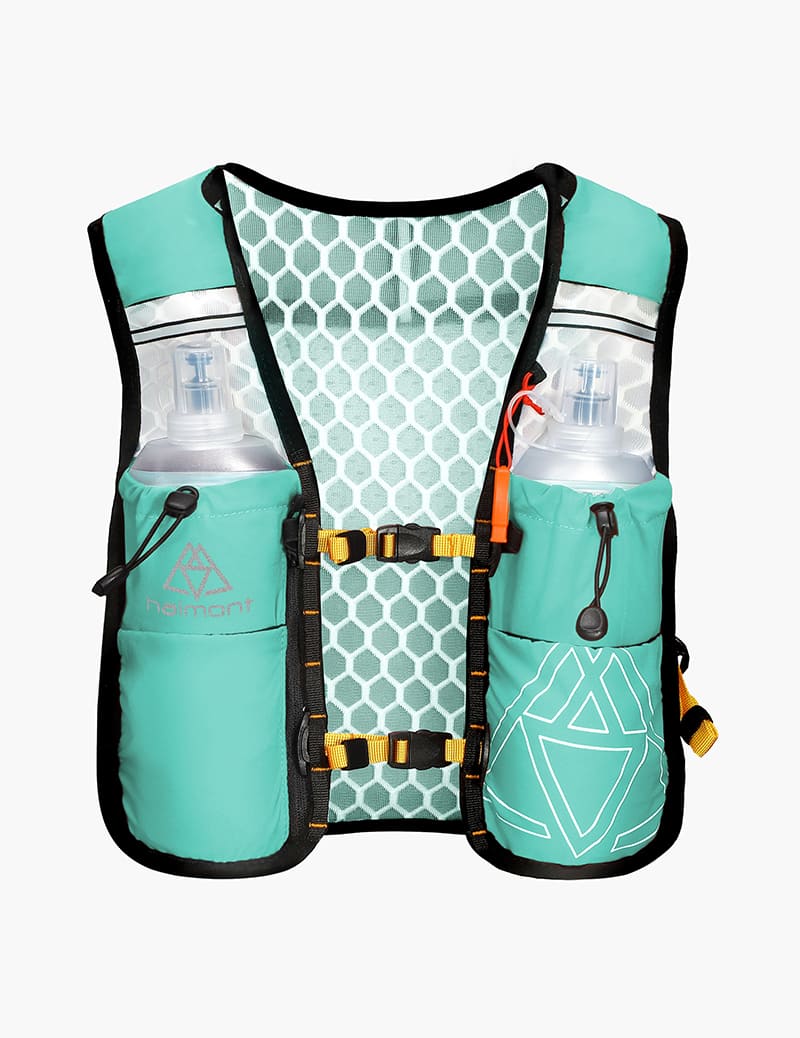
Mesh is defined by its woven, breathable structure, often found in back panels and inside shoulder straps.
- Superior Ventilation: Promotes airflow, wicks sweat, and aids temperature regulation.
- Elastic-Mesh Blends: Combine breathability with stretch for a snug dynamic fit (Isaiah Di Domenico et al., 2022).
Note: Mesh fabric on its own offers limited abrasion resistance and strength, so it’s typically reinforced with high-toughness fibers or used in low-friction areas.
Key Fabric Performance Metrics
Assessing a single material isn’t enough. Trail running vest packs rely on several key performance indicators:
Abrasion Resistance
Abrasion resistance determines the lifespan of a fabric under frictional conditions. A commonly used testing standard is the Martindale Abrasion Test (Dean McClements, 2024):
- High-denier nylon: ≥50,000 cycles without visible wear.
- Standard polyester: 30,000–45,000 cycles shows wear.
For packs exposed to rocks and shrubs, high-abrasion nylon is more reliable.
Tensile & Tear Strength
These two strength indicators reflect the fabric's durability under load and dynamic stretching:
- Nylon fibers typically have a tensile strength of 75–95 MPa, higher than polyester's 55–80 MPa.
- Nylon also resists tearing better, ideal for main load-bearing areas.
Water Resistance & DWR
Running vests don't necessarily need to be completely waterproof, but DWR finish can effectively protect against light rain and dew.
- PU/DWR coated nylon has a hydrostatic pressure of approximately 12,500 mm, and polyester approximately 9,800 mm (ISO 811).
- Water repellency will decrease with use and washing, but can be restored with a special spray.
Breathability & MVTR
Breathability affects back heat and moisture comfort:
- High-performance breathable fabrics: 5,000–30,000 g/m²·24h MVTR (ASTM E96).
- Use high MVTR materials in back and contact zones for dry comfort on long runs.
Absorption & Drying Speed
The water absorption rate of a fabric affects its weight when wet and its drying efficiency:
- Polyester has a water absorption rate of < 0.4–0.8%, resulting in less weight gain when wet and faster drying.
- Nylon has a water absorption rate of approximately 2–5%, and dries more slowly when untreated.
UV & Weather Resistance
Prolonged sun exposure can degrade fibers:
- Polyester itself has good UV stability and high strength retention.
- Nylon requires the addition of UV-resistant additives or coatings to improve its weather resistance.
Systematic Fabric Engineering: How Zones Work Together
High-performance running vests don’t rely on a single material, but rather on a regional combination design of fabrics based on function. Designers combine fabrics according to body zone functions to achieve comfort, stability, and durability for technical terrain and long runs.
| Fabric | Core Function | Typical Use Zone |
| Ripstop Nylon | Tear & abrasion resistance | Body panels, high-friction areas |
| Polyester | Quick-dry, weatherproof, UV | Linings, pockets, back panel outer layer |
| Elastic Fiber | Dynamic fit, reduce bounce | Shoulder straps, side panels, chest |
| High-Breathable Mesh | Ventilation, sweat-wicking | Back panel inner layer, shoulder straps |
The ultimate goal of all these combinations is to make the vest bag a stable, "breathable," and reliable partner in actual combat that you can forget you're even there.
Choosing Fabrics for Your Trails
By Terrain: Conquer the challenges beneath your feet
Technical Trails (rocks, shrubs, high abrasion)
Need: Extreme abrasion and tear resistance. The fabric needs to withstand continuous scratches and impacts.
Fabric: Prioritize backpacks using high-density nylon (such as 210D and 420D) as the main fabric and featuring a Ripstop ripstop weave. This combination significantly reduces the risk of being snagged by branches or rocks, ensuring the reliability of the gear in harsh environments.
Open Trails / Meadows
Need: Heat dissipation and comfort. Low risk of friction, but high heat dissipation requirements.
Fabric: Focus on a combination of highly breathable mesh back panel and quick-drying polyester fabric. This maximizes airflow, quickly wicks away sweat, and keeps the back dry during long runs
By Distance & Load
Short Speed Runs (≤15 km)
- Capacity: Approximately 5L, minimal weight
- Fabric : Breathable, dynamic fit with elastic & mesh
Mid-Long Exploration (15–35 km)
- Capacity: An ideal capacity is around 8L
- Fabric : Blend abrasion-resistant nylon with elastic mesh for stability & ventilation
Ultra / Multi-Day (>35 km)
- Capacity: Demand is over 10L
- Fabric : All-around durability, reinforced high-strength nylon, DWR, UV protection, engineered load stability
By Climate & Environment
Wet / Rainy Conditions
Need: Keep gear dry
Fabric: Choose fabrics with a durable DWR coating. This allows rainwater to bead up and roll off the fabric, buying precious time for the inside. It should be used with a professional waterproof compartment or a separate rain cover.
Hot / Sunny Conditions
Need: Heat management & sun protection
Fabric: Special attention is paid to the fabric's moisture wicking ratio (MVTR) and UV protection. Highly breathable mesh, light-colored reflective outer layers, and fabrics containing UV-resistant additives effectively help cool the garment and protect the strength of its fibers.
Crossing terrain, distance, and climate considerations narrows your ideal pack choices efficiently.

Five Steps to Lock in Your Perfect Trail Running Vest
Define Your Use Case
What kind of terrain do you run on most? How far do you usually go? And what weather conditions do you face?
These answers help you prioritize what really matters—abrasion resistance, breathability, and water resistance.
Check Fabric Zones
A good running vest is built in zones, not from a single fabric. Pay close attention to the areas that matter most:
- Shoulder & back: Are they made of breathable mesh and elastic fibers? Is the fit comfortable and friction-free?
- Main body: Does it possess sufficient abrasion and tear resistance?
- Seams & stress points: Are they reinforced? Are the seams strong?
Balance Capacity & Fabric Weight
Bigger isn’t always better. Capacity directly affects fabric choice and overall construction.
- 5L: Suitable for short-distance, lightweight, and fast running, the fabric is lighter and more breathable.
- 8L–10L: Suitable for medium to long distances, it needs to balance abrasion resistance and zoned loading, and the fabric combination needs to be more sophisticated.
Try & Test
If possible, try the running vest on and simulate running. Pay attention to how the fabric stretches, how the vest moves with your body, and whether it stays stable when you pick up the pace.
Fabric Technology & Long-term Quality
Modern running vests benefit from better fabric construction—stronger abrasion resistance, longer-lasting DWR treatments, and stretch fabrics that don’t lose their shape over time. A well-built vest performs more consistently and holds up better across real trail miles.
Trail running vests are far more than “water carriers.” They’re engineered for terrain, rhythm, load, and comfort. Fabric choice is the core—different materials provide different functions, and proper combinations unlock full performance.
By understanding fabrics and performance metrics, you can make smarter gear decisions and focus on running longer, lighter, and with confidence.